"12:14 AM — staring at the dark ceiling. If something cannot come from nothing, then nothing was never empty to begin with."
It was midnight. I was lying in bed, staring at the ceiling, and a question popped into my head the way questions do when you should be sleeping:
Does God exist?
Not as a debate. Not to argue with anyone. Just genuinely — does God exist?
And then the next thought hit:
If God created the universe, then who created God?
And if something created God, then who created that thing? And who created that? It's an infinite loop. It never ends. You keep going back and back and back and there's always another "who made this?"
So I flipped the question. Instead of asking "who made the universe," I asked:
How did the universe actually start?
Because if you can figure out how reality itself began — from scratch, from absolutely nothing — then maybe you can answer whether a "creator" was even needed.
And that question broke my brain. In the best possible way.
PART 02✦The Quantum Sea
Imagine Nothing
"Casimir proved it in 1948: even a perfect void exerts real physical pressure. Empty space is alive with quantum potential."
Try this right now. Close your eyes and imagine nothing.
Not darkness — because darkness is something. It's the absence of light, but it exists in space. And space is something.
Not silence — because silence is the absence of sound, but it exists in time. And time is something.
I mean nothing. No space. No time. No particles. No energy. No up or down. No distance between any two things because there aren't two things. There isn't even one thing.
Can you do it?
No. You literally can't. Your brain can't process it because it's trying to create a "container" called "nothing" and that container itself is something.
And here's the thing — physics agrees with you.
Nothing Is Impossible
This isn't philosophy. This is math.
There's a foundational law in quantum physics called the Heisenberg Uncertainty Principle. In physical terms, it reveals something astonishing:
A quantum field can never come to an absolute, frozen standstill. It must always fluctuate.
The governing uncertainty relation and ground state energy:
\Delta E \cdot \Delta t \ge \frac{\hbar}{2} \quad \text{and} \quad E_0 = \frac{1}{2}\hbar\omega
Quantum Ground State: Irreducible zero-point energy (\(E_0\)) prevents absolute nothingness.
What this means in plain language: in classical physics, you could imagine an inert void where every field is frozen at zero. But quantum mechanics strictly forbids this. If a field had both zero strength and zero rate of change at the same time, it would violate quantum uncertainty. To exist at all, empty space must hum with an irreducible minimum energy — called zero-point energy.
So here's the first big realization:
Absolute nothing has never existed. It can't. The most "empty" thing that can possibly exist is what physicists call the quantum vacuum. And the quantum vacuum is not empty.
It's full of energy. Tiny particles are constantly popping into existence and disappearing. The "empty space" between atoms is vibrating, fluctuating, alive with what's called zero-point energy — the minimum energy that must always be present.
And this isn't just theory. They've proven it.
The Proof: The Casimir Effect
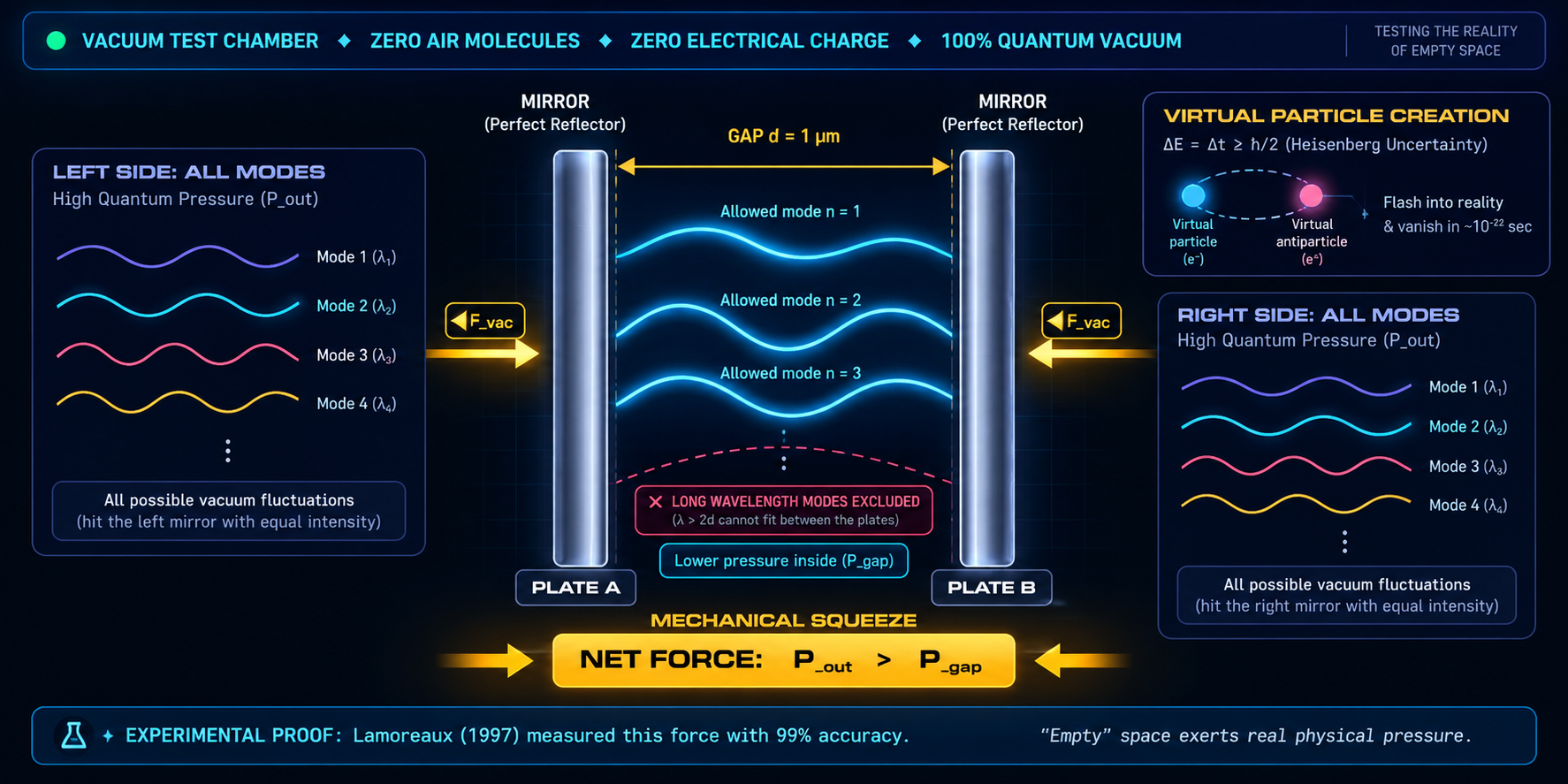
In 1948, a Dutch physicist named Hendrik Casimir made a prediction. He said: take two metal plates. Put them very close together in a perfect vacuum — no air, no particles, nothing between them. If the vacuum is truly empty, nothing should happen.
But something does happen. The plates get pulled toward each other by an invisible force.
Why? Because the "empty" space between the plates actually has fewer vacuum fluctuations than the space outside. The imbalance creates a real, measurable pressure.
In 1997, Steve Lamoreaux at Los Alamos measured it. In 1998, Mohideen and Roy at UC Riverside confirmed it with 99% accuracy.
The vacuum pushes. It has energy. It is physically real.
So now we know: nothing can't exist. The most empty state possible still has energy. Let that sink in.
Diagram 01 — Physical Proof: The Casimir EffectHow "empty" space pushes uncharged metal plates together with real mechanical force
🔬Evidence: The Casimir Effect (1997)Experimentally Verified
Steve Lamoreaux at Los Alamos National Laboratory measured the attractive force between two gold-coated plates separated by 0.6–6 micrometers. The measured force matched Casimir's 1948 prediction within 5% — later refined to 1% by Mohideen & Roy (1998). This proved the quantum vacuum contains real energy.
"Energy cannot be created or destroyed. Therefore the Big Bang was an elastic snap, not a magical birth from zero."
OK so the vacuum has energy. What does that energy do?
Think of a rubber band.
When a rubber band is just sitting on a table, it has potential energy — the ability to snap. It's not doing anything yet, but the potential is there.
Now stretch it. Keep stretching. The tension builds. The energy increases. The molecules in the rubber are straining against each other.
What happens when you hit the limit?
It snaps.
And when it snaps, all that stored potential energy transforms — into motion, heat, sound. The energy doesn't disappear. It changes form.
Now imagine this at a cosmic scale.
The Cosmic Rubber Band
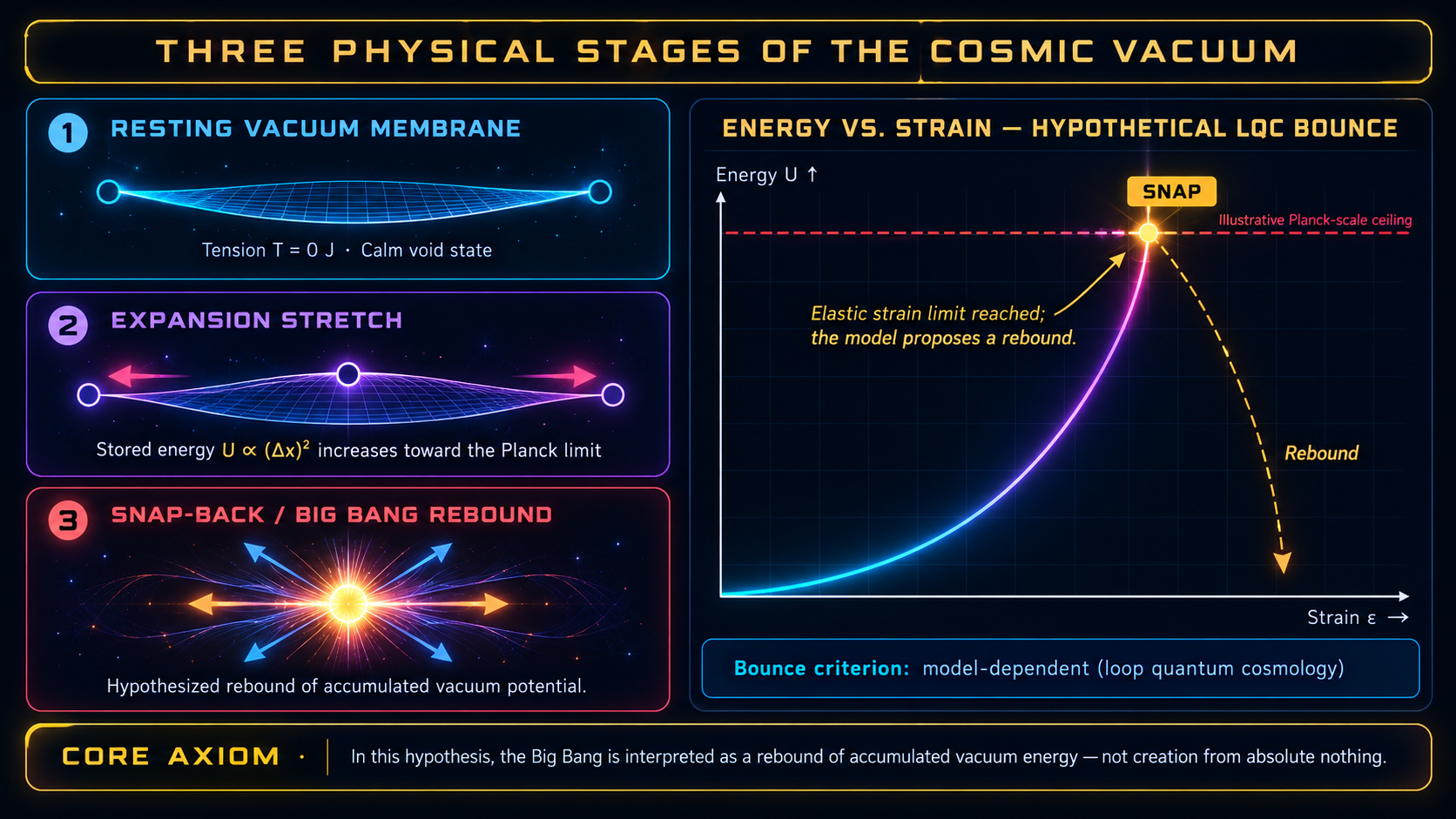
The vacuum has energy. And energy, by its nature, isn't static — it fluctuates. Sometimes a fluctuation is small. Sometimes it's bigger. And very, very rarely, a fluctuation is so large that it crosses a threshold.
Think of it like this:
Vacuum exists — full of zero-point energy, constantly fluctuating
Fluctuations grow — energy accumulates in a region, like stretching a rubber band
Threshold reached — the "rubber band" snaps
BANG — energy transforms from vacuum energy into radiation, particles, space, time
That's the Big Bang.
The Big Bang wasn't the moment the universe was "created." It was the moment energy changed form — from vacuum energy to the hot, dense soup of particles and radiation that eventually became stars, planets, and you.
This isn't me making this up. Three separate teams of physicists have built mathematical models for exactly this:
Roger Penrose (Nobel Prize 2020) — says the universe goes through infinite cycles called "aeons"
Paul Steinhardt & Neil Turok (Princeton & Cambridge) — say parallel membranes in higher dimensions collide, bounce apart, and collide again
Abhay Ashtekar & Martin Bojowald — showed mathematically that when a universe contracts, quantum effects prevent it from crushing to a point. Instead, it bounces — like a ball hitting the floor
All three models agree on one thing: the Big Bang was not the beginning. It was a transition.
And after the transition? The universe expands. Things cool down. Gravity pulls matter together. Stars form. Planets form. Life forms. Consciousness forms.
And then? Eventually, everything decays. Stars die. Black holes evaporate. And the cycle... sets up to repeat.
Diagram 02 — Spacetime Rubber Band: Tension & The SnapHow vacuum fluctuations accumulate elastic strain until reaching the Planck density rebound
This Changes Everything About "Creation"
Here's why this matters for the original question — does God exist?
If the universe has always been cycling — if there was no "first moment," if energy has always existed and just keeps changing form — then you don't need a creator who stands outside the system and presses a start button.
The system runs itself. Energy transforms, cycles, restructures. The process of creation IS the universe. There's no separate creator needed.
But that doesn't mean there's no "God." It means we've been asking the wrong question. More on this later.
🔬Evidence: Loop Quantum Cosmology — The Big BounceMathematically Proven
Abhay Ashtekar and Martin Bojowald showed that in Loop Quantum Gravity, quantum effects create a repulsive force at extreme densities. Instead of a singularity, the universe bounces — contracting to Planck density, then rebounding into expansion. Three independent teams (Penrose, Steinhardt-Turok, Ashtekar-Bojowald) all converge on cycles.
"The Sanskrit texts called it Kalpa. Penrose calls it Aeons. Two languages describing the exact same cosmic breath."
Inhale, Exhale, Repeat
You breathe in. Your lungs fill. You hold for a moment. You breathe out. Your lungs empty. A pause. Then another breath.
You've been doing this every few seconds since the day you were born. You'll do it until the day you die. You don't think about it. It just happens.
The universe does the same thing.
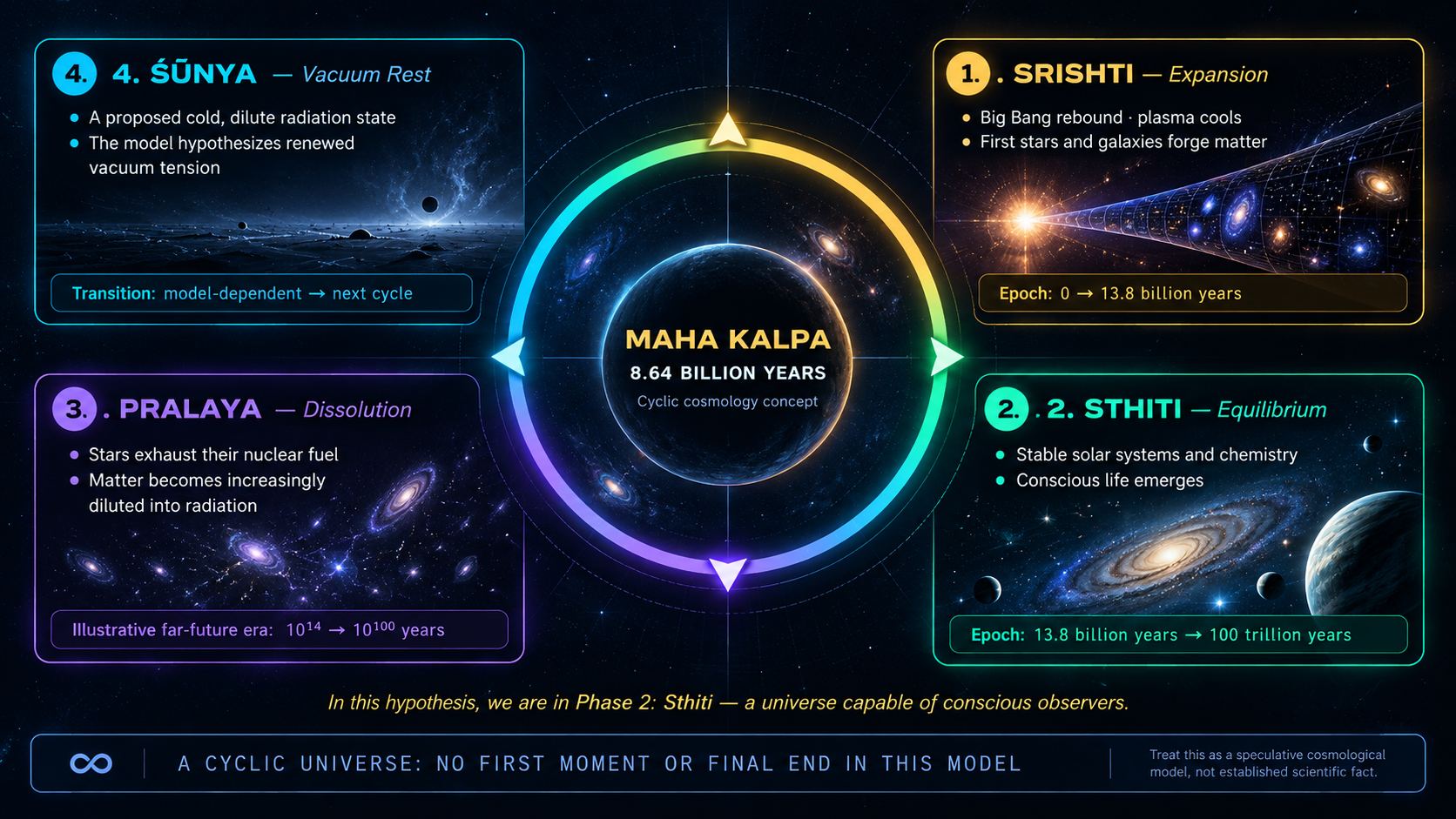
Inhale → Big Bang. Energy floods into spacetime. The universe expands.
Hold → The universe sustains itself. Stars burn. Planets orbit. Life evolves.
Exhale → Everything decays. Stars die. Matter dissolves into radiation.
Pause → The vacuum recharges. Conditions reset.
Inhale → New Bang. New cycle.
This isn't a metaphor I invented. This is what cyclic cosmology literally describes. And this is exactly what Hindu cosmology has been saying for thousands of years:
Three stages. Infinite cycles. No beginning. No end.
Vast Deep Time: Ancient Intuition Meets Modern Astrophysics
While ancient Western chronologies counted cosmic history in mere thousands of years, Vedic cosmology intuited time on a truly staggering scale. It calculated that one "Day of Brahma" (a Kalpa) lasts 4.32 billion years.
For perspective: the radiometric age of planet Earth is 4.54 billion years. One complete cycle of day and night (8.64 billion years) remarkably mirrors the main-sequence lifetime of our Sun (~10 billion years). And the overarching cosmic lifespan of 311 trillion years approaches the modern astrophysical estimate for the Stelliferous Era (~100 trillion years), after which star formation ceases.
This is not a claim of literal decimal-level identity; rather, it reveals something far more profound: ancient thinkers intuitively grasped the true orders of magnitude of cosmological deep time millennia before the invention of telescopes or radiometric dating.
Carl Sagan — one of the most famous astrophysicists in history — emphasized this on his TV show Cosmos in 1980:
"The Hindu religion is the only one of the world's great faiths dedicated to the idea that the Cosmos itself undergoes an immense, indeed an infinite, number of deaths and rebirths. It is the only religion in which the time scales correspond to those of modern scientific cosmology."
How did early contemplative thinkers arrive at timescales of billions and trillions of years — cosmic orders of magnitude that contemporary physics and geology now validate with modern instrumentation?
At CERN — the European Organization for Nuclear Research in Geneva, home of the Large Hadron Collider, the most powerful particle accelerator ever built — there stands a 2-meter bronze statue.
It's not Einstein. It's not Newton. It's not any scientist.
It's Nataraja — Shiva performing the cosmic dance.
Why? Because what happens inside the Large Hadron Collider — particles being created, colliding, annihilating, creating new particles — is exactly what the dance represents. Creation and destruction happening simultaneously, forever, at the subatomic level.
The Indian Department of Atomic Energy gifted this statue to CERN in 2004. The plaque next to it carries a quote from physicist Fritjof Capra:
"Modern physics has shown that the rhythm of creation and destruction is the very essence of inorganic matter. For the modern physicist, Shiva's dance is the dance of subatomic matter."
Krishna and Time
In the Mahabharata, there's a moment in the Bhagavad Gita (Chapter 11) where Arjuna asks Krishna to show his true form. What Krishna reveals is terrifying.
Arjuna doesn't see a person. He sees everything — all of time, all of space, all universes, all creation and all destruction happening simultaneously. Warriors being born and dying. Stars forming and exploding. Entire civilizations rising and falling in the blink of an eye.
And Krishna says:
कालोऽस्मि लोकक्षयकृत्प्रवृद्धो "I am Time, the great destroyer of worlds." (Gita 11.32)
Not "I am the Creator." Not "I created time." I AM Time. Time isn't something God uses. Time IS the process. The cycle of creation and destruction IS the divine.
This maps perfectly to cyclic cosmology. There is no creator standing outside the clock. The clock IS the creator.
🔬Evidence: Penrose CCC & Vedic Timescale CorrelationTheoretical Model
Roger Penrose's Conformal Cyclic Cosmology (CCC) proposes that the end of one aeon — when all mass decays into pure radiation — conformally maps to the beginning of the next Big Bang. Vedic timescales (4.32 billion year Brahma cycles) remarkably align with modern geological and astrophysical measurements within the same order of magnitude.
"95.1% of reality is completely invisible to our telescopes. We are rare conscious sparks floating on a dark sea."
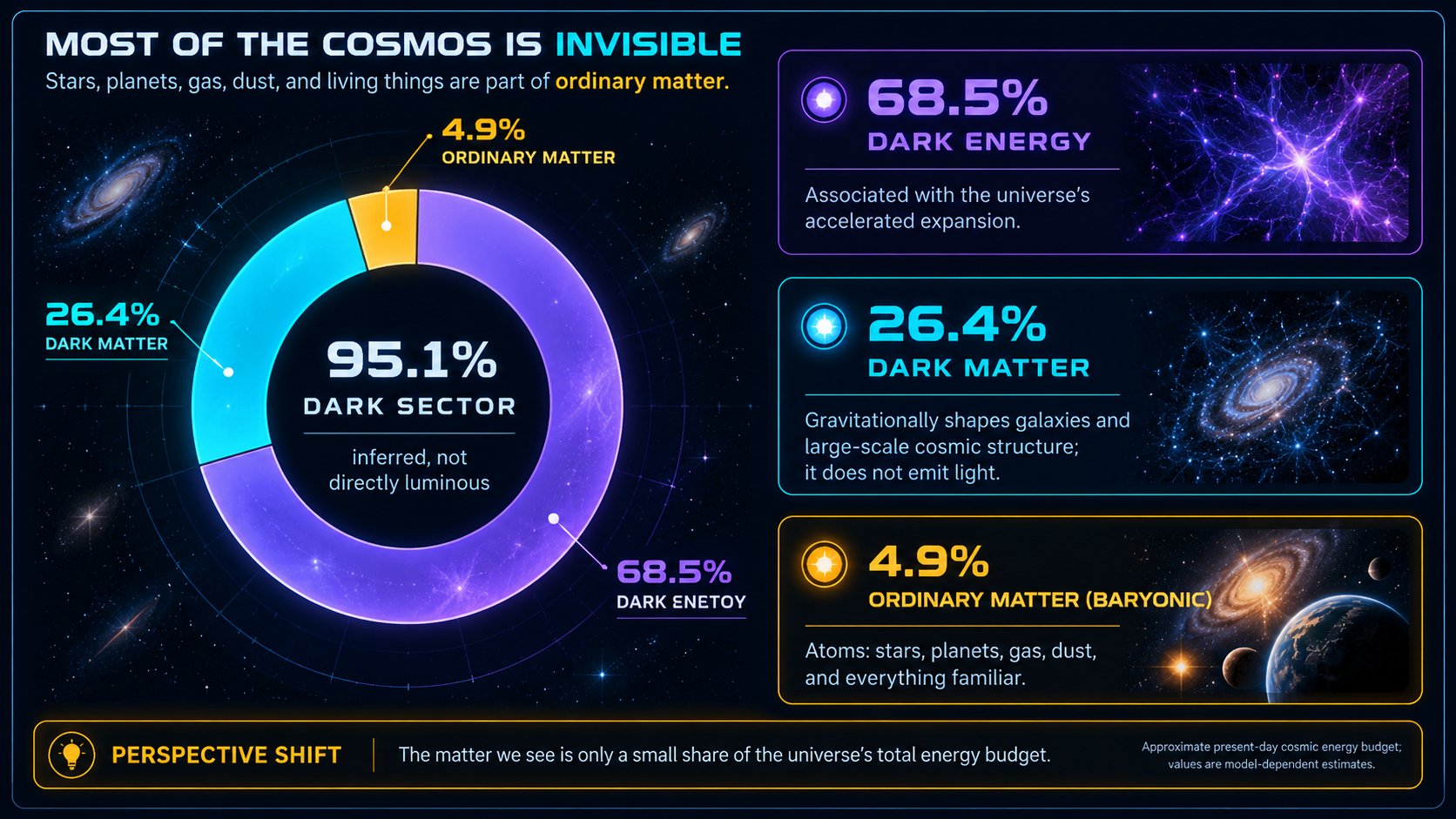
Most people think the universe is made of the stuff we can see — stars, planets, rocks, water, air, people. They're wrong. All of that is less than 5% of the total.
Here's what the universe is actually made of:
Component
Percentage
What It Is
Dark Energy
68.5%
The vacuum energy driving expansion — we can measure its effects but don't know what it fundamentally is
Dark Matter
26.4%
Invisible matter that holds galaxies together — we can detect its gravity but can't see it
Normal Matter
4.9%
Everything you've ever seen, touched, or will ever touch
Radiation
0.1%
Light, radio waves, gamma rays
You, me, Earth, the Sun, every star in the night sky — we're the foam on the ocean. The universe is overwhelmingly made of things we cannot see, cannot touch, and barely understand.
Dark energy — 68.5% of everything — is essentially vacuum energy. The same vacuum energy from Chapter 2. The same energy that started the whole cycle. It's still here. It's still driving the expansion. The "rubber band" is still stretching.
Diagram 04 — Cosmic Mass-Energy InventoryPlanck 2018 Data: Dark Energy (68.5%) + Dark Matter (26.4%) + Ordinary Matter (4.9%)
The Cosmic Web
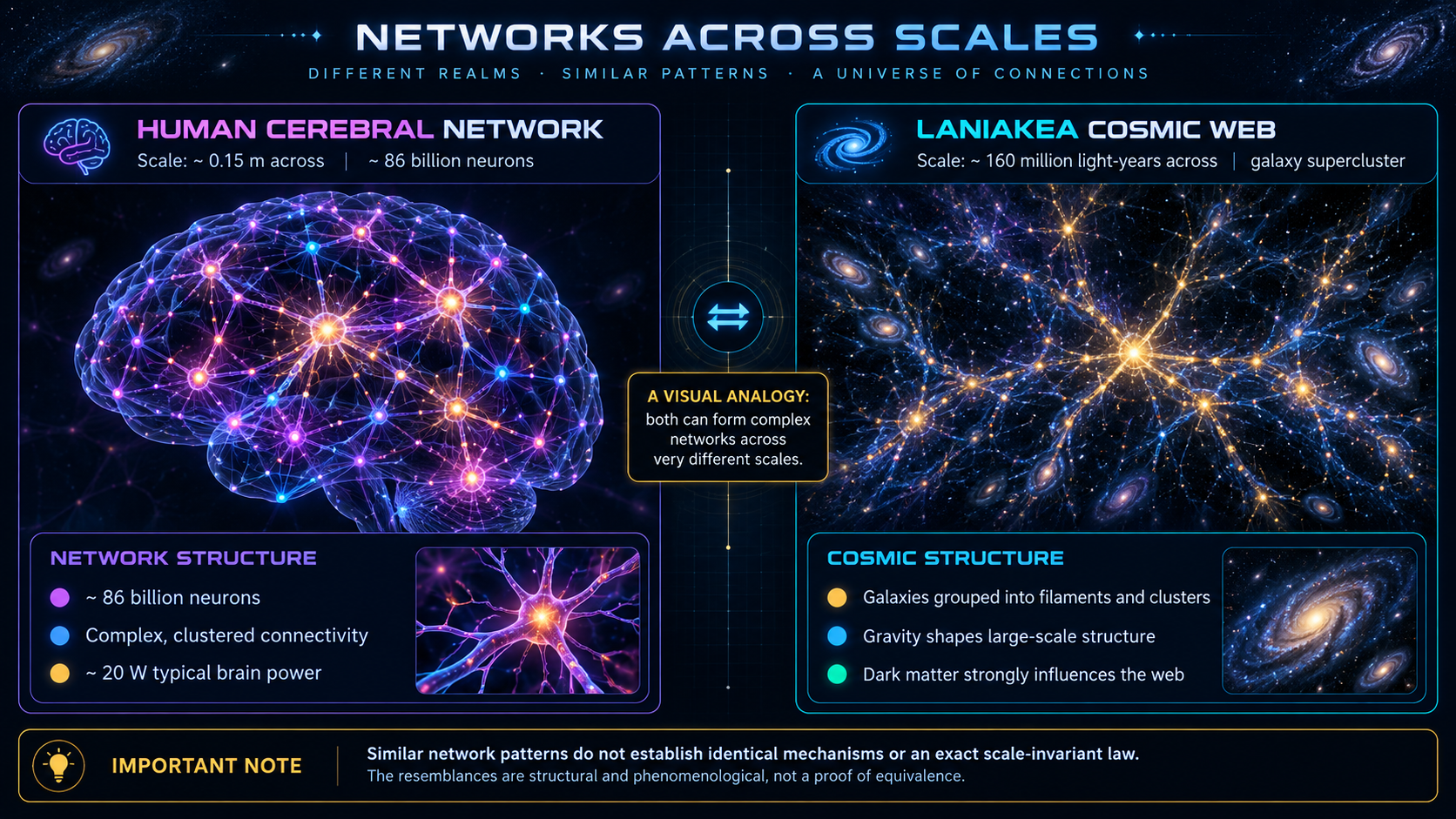
If you could zoom out and see the entire observable universe at once — 93 billion light-years across, containing 2 trillion galaxies — you'd see something that looks eerily like a neural network.
Galaxies aren't scattered randomly. They're arranged in a massive web of:
Filaments — bridges of matter hundreds of millions of light-years long
Nodes — clusters of thousands of galaxies at intersections
Voids — enormous empty regions spanning millions of light-years
This structure was seeded by quantum fluctuations — tiny random vibrations from the very first fraction of a second after the Big Bang, amplified by gravity over billions of years into the largest structures in existence.
Quantum randomness → cosmic structure. The butterfly effect on a universal scale.
The Laniakea Supercluster — our "home address" in the cosmos — spans 520 million light-years and contains about 100,000 galaxies. The Milky Way is one of them. Within the Milky Way, our solar system is one of roughly 100 billion star systems. And we're on the third rock from one of those stars.
You are a speck on a speck on a speck on a speck. And yet you're thinking about it. That matters more than the size.
🔬Evidence: Planck Satellite Data & Galaxy Rotation CurvesExperimentally Verified
The Planck satellite (ESA, 2013-2018) precisely measured the cosmic microwave background to determine the universe's composition: 68.5% dark energy, 26.4% dark matter, 4.9% baryonic matter. Vera Rubin's galaxy rotation curves (1970s) first proved dark matter exists by showing galaxies spin too fast to be held together by visible matter alone.
"Your brain consumes 20 Watts — barely enough to power a dim lightbulb — yet it simulates the entire observable universe."
The Question of Consciousness
Here's the deepest part of this theory, and the part that connects everything:
We have consciousness because we have energy.
Your brain uses about 20 watts of power — roughly the same as a dim light bulb. It converts glucose (from food) into electrical signals (neural impulses) at a rate of about 100 billion neurons firing. That's an energy process.
When that energy stops flowing — brain death — consciousness vanishes. No energy, no awareness.
But here's what's weird: physics can describe every process in your brain as electrochemical reactions. It can map every neuron, every synapse, every signal. And none of that explains why you feel anything.
Why does the color red look like something? Why does music move you? Why is there an inner experience at all? A perfect robot could process the same information without feeling a thing.
This is called the Hard Problem of Consciousness, named by philosopher David Chalmers in 1995. And no one has solved it.
Three Scientific Theories That Support the Connection
1. Integrated Information Theory (Giulio Tononi, 2004):
Any system that integrates information — where the whole does more than the sum of its parts — has some degree of consciousness. Your brain, with its billions of recurrent connections, has a LOT of integrated information. A thermostat has almost none. But the threshold isn't zero — even simple systems might have a trace.
Roger Penrose (the same guy who proposed cyclic cosmology) and anesthesiologist Stuart Hameroff argue that consciousness involves quantum processes in brain cells. They believe microtubules — tiny structures inside neurons — support quantum computations that connect consciousness to the fundamental level of spacetime.
3. Panpsychism (Leibniz, Chalmers, Philip Goff):
The oldest and most radical idea: consciousness isn't something brains create. It's a fundamental property of matter itself — like mass or charge. Every particle has a tiny trace of experience. Complex consciousness (like yours) emerges when trillions of these traces integrate.
The Quantum Observer & Physical Actuality
Here's a mystery that has challenged physicists for a century:
In quantum mechanics, before a physical system interacts with a measuring environment, it doesn't possess a single definite configuration. It exists in a superposition — a spectrum of probabilities where all potential outcomes co-exist.
When physical measurement or thermodynamic interaction occurs, the superposition transitions — through quantum decoherence — into one concrete, definite reality.
In the laboratory, any macroscopic detector triggers this transition. But legendary physicists like John Wheeler, Eugene Wigner, and Erwin Schrödinger pushed this question to its cosmic conclusion: What gives the universe as a whole its reality? Wheeler termed this the "Participatory Universe":
"No phenomenon is a phenomenon until it is an observed phenomenon."
In Wheeler's vision, reality is not an inert stage that existed silently for billions of years waiting for spectators. Rather, the universe evolves physical complexity, chemistry, and conscious observers so that it can look back upon itself — actualizing its own existence in an unbroken participatory loop. Consciousness is not an accidental stranger; it is the universe achieving self-awareness.
Erwin Schrödinger Knew This
Schrödinger — the man who created the equation that describes how all quantum systems evolve — was an avid student of Indian philosophy. He wrote:
"Consciousness is a singular of which the plural is unknown. There is only one thing and what seems to be a plurality is merely a series of different aspects of this one thing."
"This, as the Brahmins express it: Tat Tvam Asi — You are That."
"You are That." Your consciousness isn't separate from the universe. It IS the universe — locally aware, temporarily focused through the lens of your brain, looking at itself.
You're not IN the universe the way a fish is in water. You're the universe the way a wave is the ocean. Not separate. Not contained. Made of the same stuff, shaped by the same forces, part of the same process.
In the Mahabharata, there's a story about a sage named Markandeya who is blessed with an incredibly long life. So long that he's alive when the universe ends.
He watches as the cosmic dissolution (Pralaya) begins. The oceans rise. The skies burn. The stars go out one by one. Everything he's ever known — every person, every mountain, every civilization — dissolves back into a vast, dark ocean of nothingness.
And then he sees something floating on that ocean: a tiny baby, lying on a banyan leaf, glowing with light. The baby is Vishnu — and the entire universe that just dissolved is contained inside that child.
Markandeya is swallowed by the child and finds himself inside a complete new universe — with new stars, new planets, new people. He lives there for millennia. Then the child exhales, and Markandeya is outside again, floating on the dark ocean, watching another cycle begin.
This story isn't "mythology" in the way we dismiss fairy tales. It's a cosmological model — described through narrative because mathematics hadn't been formalized yet.
The dark ocean = the quantum vacuum. The child = the seed of the next universe (the Bindu — the singularity). The inhale and exhale = expansion and contraction. The cycle repeating = cyclic cosmology.
The people who wrote the Mahabharata didn't have the Heisenberg Uncertainty Principle. They didn't have radio telescopes. But they arrived at the same structural understanding of the cosmos — through meditation, philosophical reasoning, and something we haven't been able to scientifically explain yet: direct introspective insight.
Marcus Raichle (Washington University, 2002) measured the brain's resting metabolic rate at approximately 20 watts — 20% of body energy for 2% of body mass. The brain-cosmos topology match was demonstrated by Franco Vazza & Alberto Feletti (2020) who showed the power spectral density of the neural cortex and the cosmic web are statistically identical at scales spanning 27 orders of magnitude.
"The circle has no first cause because a circle generates itself. The process of creation IS the divine."
We started with this question. Let's answer it.
What the Theory Says
If the universe has always existed — cycling through infinite expansions and contractions — then no one created it from outside. There's no moment where a being who is not the universe decided to make the universe.
So in the traditional sense — a God who sits outside reality and creates it like a potter makes a pot — no, that doesn't exist. Because there is no "outside reality." Reality is all there is.
But.
The process itself — vacuum energy fluctuating, energy transforming, matter organizing, consciousness emerging, the cycle repeating — this process IS what every religion has been calling God.
Think about it:
Hinduism says God is Brahman — the infinite, formless reality underlying everything. Not a person. A process.
The Gita has Krishna say "I am Time" — not "I created time." He IS the cycle.
The Nasadiya Sukta (Rigveda 10.129 — the oldest hymn about creation) says the gods came AFTER the universe. Even the gods don't know how it started. Even the "supervisor" of creation might not know.
Buddhism says there is no creator God. There is Pratītyasamutpāda — dependent origination. Everything arises because of conditions, not because of a creator.
The theory doesn't say "God doesn't exist." It says:
God is not a creator separate from creation. God IS creation. The vacuum is the womb. Energy is the substance. Consciousness is the witness. The cycle is eternal. And you — you are all of it, temporarily shaped into a person, asking questions about itself.
The universe created you so it could ask "does God exist?" — and the answer is: you're looking at it. You're made of it. You ARE it.
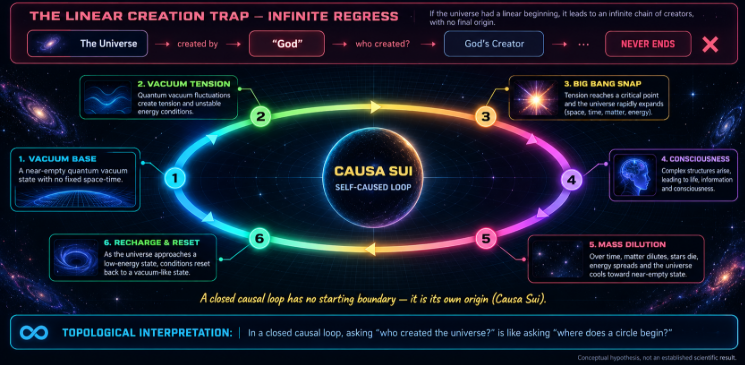
Diagram 06 — Resolving The Infinite Regress: The Self-Generating Causal LoopGott–Li Topology (1998): T = S¹ × ℝ³ — The Universe as Its Own Origin (Causa Sui)
🔬Evidence: Gott–Li Topology & Cosmological Causal LoopsTheoretical Model
J. Richard Gott and Li-Xin Li (Princeton, 1998) demonstrated mathematically that General Relativity permits the early universe to form a closed timelike curve (CTC), allowing spacetime to act as its own mother and eliminating the need for a first cause. This resolves the infinite regress problem of linear creationism.
"627 km/s towards a hidden gravitational mass. Our entire supercluster is being pulled across cosmic boundaries."
This theory doesn't claim to have all the answers. Here's what we genuinely don't know:
1. What determines the laws of physics?
If the universe cycles, does each cycle have the same laws? Or do the rules change? String Theory suggests there are 10⁵⁰⁰ possible configurations of physical law. Why this one?
2. Is information preserved across cycles?
When the universe "resets," does it start fresh? Or does information from the previous cycle carry forward? Penrose claims to have found circular patterns in the cosmic microwave background — echoes from the previous cycle.
3. What is dark matter?
It's 26% of the universe. It holds galaxies together. We can measure its gravity. But we've never directly detected a dark matter particle. Could it be "residue" from a previous cycle — structures that survived the transition?
4. What is dark energy, really?
It's 68.5% of everything. It's making the universe expand faster and faster. We know what it does but not what it IS.
5. The Consciousness Question
Is consciousness fundamental (like mass or charge) or emergent (like temperature)? If fundamental, then the universe is conscious. If emergent, consciousness is a miracle that physics doesn't fully explain. Both options are staggering.
6. Are we alone?
There are 2 trillion galaxies, each with hundreds of billions of stars, many with planets in habitable zones. The universe is 13.8 billion years old. If consciousness is an inevitable consequence of energy complexity, then conscious life should be everywhere.
So where is everyone? (This is called the Fermi Paradox.)
Maybe we're early. Maybe we're late. Maybe they communicate in ways we can't detect. Maybe the "Great Filter" — some barrier that prevents civilizations from becoming spacefaring — lies ahead of us.
Or maybe — just maybe — consciousness at a cosmic scale doesn't need spaceships. Maybe it communicates through the vacuum itself.
7. The Great Attractor & The Cosmic Bulk Flow
This observation is real, measurable, and genuinely fascinating.
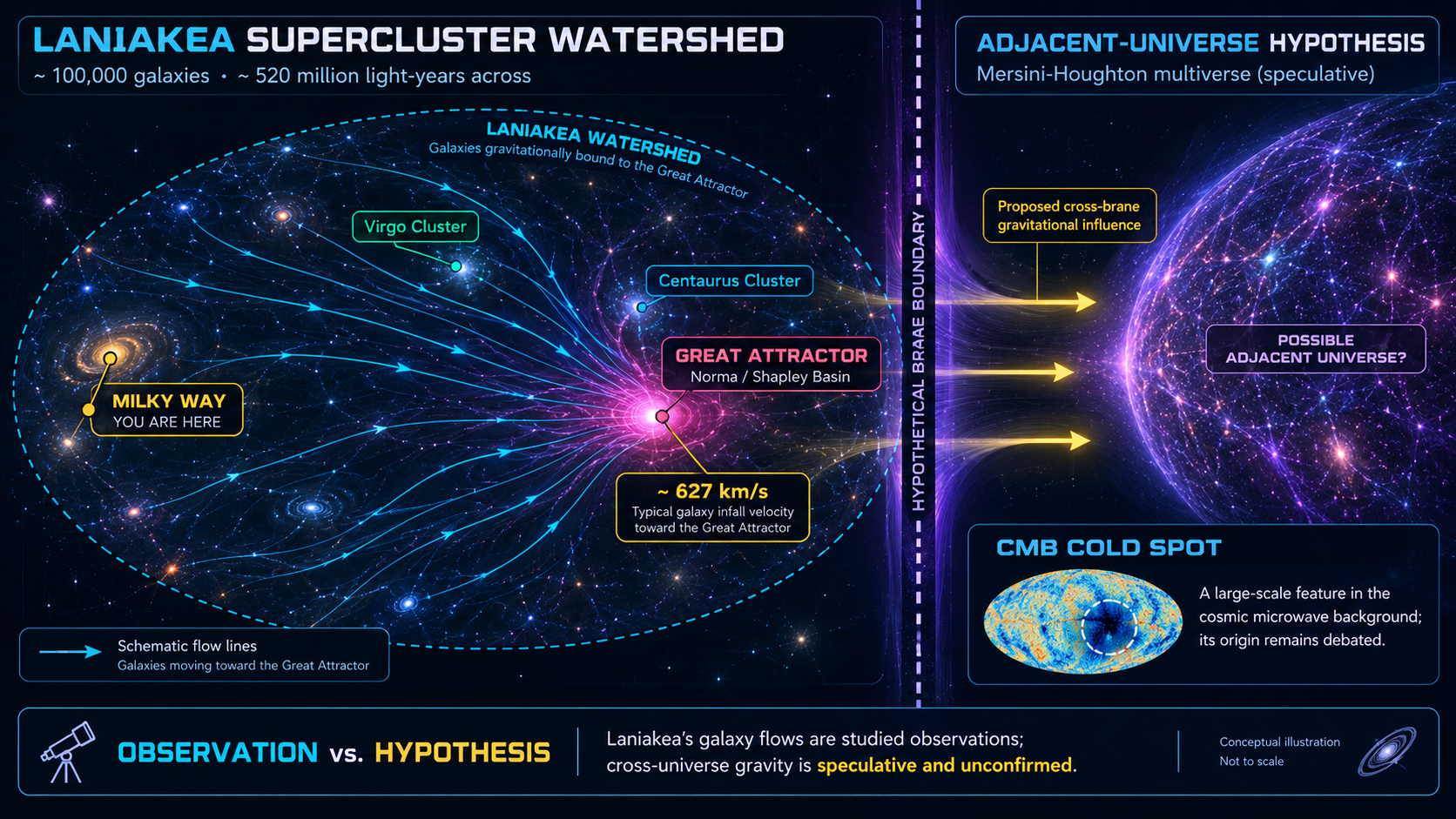
Scientists have known since the late 1970s that our galaxy — along with the entire Laniakea Supercluster, spanning a hundred thousand galaxies — is being pulled toward a specific focal region in space at roughly 600 kilometers per second (2.2 million km/h). Right now. As you read this.
The core of this gravitational basin lies behind the dense dust and star fields of the Milky Way's galactic plane — a region astronomers call the "Zone of Avoidance."
They've designated this regional gravitational convergence the Great Attractor.
In 1987, a team called the "Seven Samurai" mapped this gravitational flow, calculating a pull equivalent to tens of thousands of galaxies. Subsequent X-ray and infrared surveys pierced the galactic dust, discovering the massive Norma Cluster and confirming that our entire region is falling toward an even vaster colossus — the Shapley Supercluster, 650 million light-years away.
Yet even accounting for Norma and Shapley, cosmologists have measured puzzling, large-scale "bulk flows" — vast rivers of galaxies drifting across cosmological horizons faster than standard homogeneous models predict. This opens up a profound cosmological question:
The Multiverse Hypothesis:
If the Big Bang was not a solitary, isolated fluctuation, but one of countless phase transitions in an eternal quantum vacuum, then our cosmic bubble does not expand in total isolation. Gravitational fields from neighboring bubble universes could imprint subtle tidal pulls across cosmic horizons.
Physicist Laura Mersini-Houghton (University of North Carolina) has proposed a mathematical framework for this — suggesting that large-scale anomalies in the cosmic microwave background, such as the mysterious CMB Cold Spot (a 1.8-billion-light-year anomalous void), could represent the gravitational entanglement or boundary pressure of an adjacent universe bubble.
Whether the ultimate source of all cosmic bulk flow is entirely contained within our cosmic horizon or partially nudged by sister universes in an eternal multiverse, gravity remains the only force capable of bridging cosmic domains.
Diagram 07 — Laniakea Bulk Flow & The Neighboring Universe TugCosmicflows-3 Data: 100,000 Galaxies Rushing at 627 ± 22 km/s Toward an External Gravitational Sink
🔬Evidence: Cosmicflows-2 Data & CMB Cold SpotObserved + Hypothetical
The Cosmicflows-2 survey mapped the peculiar velocities of ~8,000 galaxies, confirming the 627 km/s bulk flow toward the Great Attractor/Shapley concentration. Laura Mersini-Houghton (UNC) proposed that the CMB Cold Spot — a 1.8 billion light-year anomalous region — may be the gravitational imprint of a neighboring universe bubble, consistent with eternal inflation models.
"The breakthrough didn't come in a laboratory. It came at 3 AM when the pieces finally clicked together."
This wasn't figured out in a lab. It wasn't funded by a university. There was no grant, no telescope, no team.
It was a 15-year-old lying in bed at 3 AM, unable to sleep, chasing a question that wouldn't let go.
The process: Unthinking.
Not rote studying. Not repetition of dogma. Unthinking. Peeling away assumptions, one by one, until only the structural skeleton of reality remained.
What existed before everything? Nothing. But nothing can't exist. So something was there. What's the most basic "something"? A vacuum. But a vacuum has energy. And energy transforms. And transformations cycle. And cycles don't need beginnings.
Every piece fell into place because every piece was already there — in physics textbooks, in Vedic texts, in the experience of breathing, in the feeling of a rubber band snapping. It just needed someone awake past midnight to connect them.
That's what midnight overthinking does. It strips you down to the bone of reality. And at the bone, everything is connected.
"And that midnight inquiry distilled itself into an unbroken story — the story of everything from scratch to eternity."
PART 10✦Fireside Reading Sanctuary
The Story — From Nothing to Everything
"You are not an accidental spectator. You are the universe looking back at itself."
🔥The Fireside Journey:Read this like someone is sitting with you by a fire under the open night sky. No equations, no technical citations — just the pure, poetic story of reality from the first tremor of the void to your own eyes reading this sentence.
Before the beginning, there was no beginning.
No space. No time. No light and no darkness. No particles, no waves, no heat, no cold. Not even emptiness — because emptiness needs a container, and there was nothing to contain.
But here's the thing about nothing: it can't hold.
Nothing is unstable. The rules that govern reality — rules that seem to exist even before the things they govern — don't allow zero. Not perfect zero. Not ever. So even in the most absolute void imaginable, there's a tremor. A flicker. An energy that exists simply because not-existing isn't an option.
This is the quantum vacuum. The lowest possible state of reality. And it's not empty. It hums.
For a timeless, spaceless, inconceivable non-duration, the vacuum hums. Fluctuations ripple through it — tiny surges of energy that appear and vanish, like bubbles forming on the surface of still water. Most are small. Most disappear before they become anything.
But one doesn't.
One fluctuation is a little bigger. A little more persistent. It stretches. Energy accumulates — the way tension builds in a rubber band pulled tighter and tighter. There is no clock to measure how long this takes because time doesn't exist yet. There is no ruler to measure how far it stretches because space doesn't exist yet. But the tension builds.
And then — the threshold.
The rubber band snaps.
Energy that was formless, directionless, and dimensionless transforms. It pours into a new configuration. In a fraction of a fraction of a second that only makes sense in retrospect because seconds are being invented right now — radiation floods into being. Space unfolds like a parachute yanked open. Time begins ticking. Temperature hits trillions of degrees. Particles condense from pure energy like ice crystals forming in supercooled air.
This is the Big Bang. Not a creation from nothing. A transformation. Energy changing costume.
The newborn universe roars. Sound waves — real acoustic density oscillations — ripple through the white-hot plasma that fills everything. These sound waves compress and stretch the plasma, creating ripples of slightly higher and slightly lower density.
These ripples will matter. Enormously.
The universe expands. It cools. After 380,000 years, it cools enough for atoms to form — hydrogen, helium, tiny amounts of lithium. The plasma clears. Light is freed. We can still see this light today — the Cosmic Microwave Background, the oldest light in the universe, a faint glow filling every direction of the sky.
But those density ripples from the first moments are now frozen into the distribution of matter. Where the ripples were slightly denser, gravity is slightly stronger. Matter begins falling toward those points. Slowly. Over millions of years.
Dark matter — invisible, intangible, making up 26% of everything — falls first. It clumps along the density ripples, forming a web. A scaffold. An invisible skeleton for the universe.
Normal matter follows, sliding along the dark matter scaffolding like water along grooves in a hillside. Gas collects in pools. Pools compress. Temperature rises. And then — ignition.
The first stars are born.
They are monsters. Hundreds of times more massive than our Sun. They burn fast and die young — in mere millions of years — and when they die, they explode. Supernovae. And in those explosions, something miraculous happens: the intense heat and pressure forge new elements. Carbon. Oxygen. Nitrogen. Iron. Gold. Every atom heavier than lithium was cooked inside a star that died.
You are made of dead stars. Literally. The iron in your blood, the calcium in your bones, the oxygen you're breathing right now — all of it was forged in stellar cores billions of years ago and scattered across space when those stars exploded.
New stars form from the wreckage. Smaller, calmer stars — like our Sun. Around them, leftover debris clumps into planets. On one particular planet, third from a medium yellow star in an unremarkable arm of a spiral galaxy, something new happens.
Chemistry gets complicated.
Molecules link into chains. Chains fold into structures. Structures begin copying themselves. Life.
It starts simple — single cells, huddled near volcanic vents at the bottom of oceans. For nearly two billion years, that's all there is. Then cells merge. Complexity leaps. Multicellular life explodes across the planet. Fins. Eyes. Bones. Brains.
The brains get bigger. More connected. More recurrent. And somewhere in that tangle of neurons, firing electrochemical signals at 20 watts of power, something emerges that physics cannot fully explain:
Consciousness.
The universe opens its eyes. For the first time in 13.8 billion years, a piece of the cosmos looks up at the night sky and asks: "What is all this?"
That's you.
You are not a thing that lives in the universe. You are the universe, locally aware. A temporary arrangement of atoms that was once scattered across a dozen dead stars, briefly organized into a pattern that can wonder about its own existence.
And the universe keeps going.
Right now, dark energy — 68.5% of everything, the vacuum energy that started this whole process — is pushing the universe apart faster and faster. Galaxies are flying away from each other. And something massive pulls our entire supercluster — a hundred thousand galaxies — toward it at 600 km/s. The Great Attractor, anchored by deep cosmic structures, and perhaps carrying the gravitational pull of sister universes nucleating in an eternal multiverse beyond.
Stars will die. One by one. The last red dwarfs will flicker out in about 100 trillion years. Over inconceivable cosmological epochs, mass-energy dilutes and decays across the vast expanding void. Gradually, all structured matter converts back into pure radiant energy.
And then? Nothing but radiation. Photons. Particles traveling at light speed, so spread out and cold that distance and time lose all physical meaning. Spacetime returns to its scale-invariant ground state. The universe has exhaled completely.
But the vacuum is still there. It was there before the Big Bang and it's here after everything else is gone. And it still can't be zero. Fluctuations still ripple. Energy still hums.
And one fluctuation is a little bigger. A little more persistent. The tension builds...
The rubber band stretches...
And snaps.
A new universe screams into being. New particles, maybe new laws, new structures, new stars, new planets, new chemistry, new consciousness — new eyes opening to ask the same question:
"What is all this?"
And the circle continues. As it always has. As it always will.
Not because someone made it this way. But because nothing — true, absolute, perfect nothing — was never an option.
The circle has no beginning. The circle has no end. And you are the circle, briefly aware of being a circle, reading these words at this exact moment in one of infinite turns.
That's the Cosmic Rubber Band Theory.
That's what a 15-year-old figured out at 3 AM because sleep wouldn't come and the question wouldn't stop.
PART 11✦The Architectural Synthesis
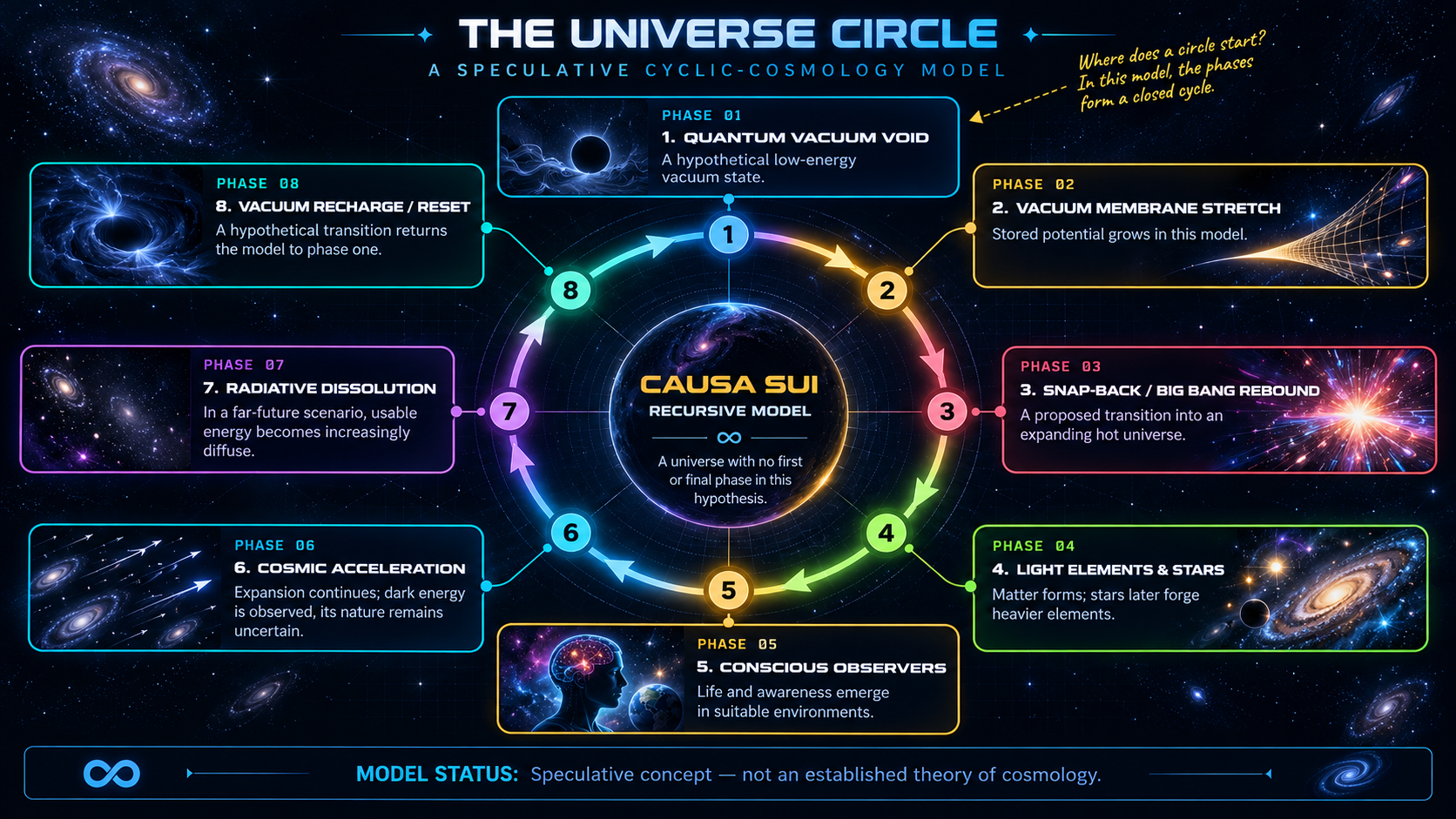
The Master Synthesis: The Universe Circle & Causa Sui Loop ♾️
"Where does a circle start? It doesn't. It's an eternal, self-causing loop."
Here is the complete cosmic architecture distilled into an unbroken causal sequence — tracing reality from the quantum ground state through the emergence of mass, chemistry, consciousness, deep-time radiation, and the conformal scale reset:
Diagram 08 — The Universe Circle: The Infinite Cosmic CycleThe Complete Journey: From Quantum Ground State → The Snap → Atoms & Consciousness → Radiative Exhale → Vacuum Reset ♾️
01Quantum Foundation
The Ground State Void: Nothingness Cannot Exist
\Delta E \cdot \Delta t \ge \frac{\hbar}{2}
True absolute nothingness is physically and mathematically impossible. The Heisenberg Uncertainty Principle dictates that a state of absolute zero energy cannot endure for any duration. The ground state of reality is the quantum vacuum, ceaselessly humming with virtual field activity and zero-point energy (empirically confirmed by the Casimir Effect).
"Nothingness has no ground to stand on; zero is mathematically forbidden."
Within the timeless vacuum floor, virtual particle-antiparticle pairs continuously bubble into and out of existence. While nearly all fluctuations vanish instantly, one fluctuation persists and stretches — resisting immediate collapse and accumulating sustained potential energy.
"Out of trillions of ephemeral ripples, one persistent spark refuses to vanish."
03Elastic Accumulation
Elastic Tension: Potential Energy Builds Toward Planck Limit
The persistent fluctuation stretches coordinate space like a cosmic rubber band. With neither external clocks nor rulers yet existing, potential elastic energy accumulates inside the curvature of the expanding mode, driving matter-energy density relentlessly toward the Planck ceiling (\sim 5.1 \times 10^{96}\text{ kg/m}^3).
"Pulling the cosmic rubber band tighter and tighter until reality reaches its breaking point."
04Cosmic Phase Transition
The Snap & Big Bang Rebound: Threshold Breached at ρ_Planck
Energy density breaches the quantum bounce threshold (\rho_c \approx 0.41 \cdot \rho_{\text{Planck}}). Spacetime cannot compress further; the rubber band snaps and elastically rebounds. Stored potential energy uncoils instantaneously into primordial radiation, quarks, gluons, metric space, and time. The Big Bang is not an emergence from nothing, but an elastic phase transition of vacuum energy.
"Not creation from nothing — energy changing costume in an explosive cosmic snap."
05Thermal Decoupling
Recombination & The First Light: Light Freed at 380,000 Years
Acoustic sound waves churn through the primordial plasma, leaving spherical density ripples. As spacetime expands and cools to ~3,000 K after 380,000 years, electrons bind with nuclei into neutral atoms. The plasma clears, and photons decouple to stream freely across the universe — forming the Cosmic Microwave Background (CMB), the oldest light in existence.
"The plasma fog clears, and the ancient flash of the first dawn travels unimpeded forever."
06Structure Formation
Dark Matter Scaffolding & Stellar Crucible: Web & Nucleosynthesis
Cold dark matter condenses along the primordial density ripples, weaving an invisible gravitational scaffolding across hundreds of millions of light-years. Hydrogen gas slides into these dark matter wells, compressing to ignite the first generation of massive stars. In violent supernova explosions, stellar cores forge the elements of the periodic table: carbon, oxygen, nitrogen, iron, and gold.
"Every atom of iron in your blood and oxygen in your lungs was cooked in an exploding star."
07Chemical Complexity
Planetary Systems & Chemical Complexity: Chemistry Becomes Life
Supernova debris seeds second- and third-generation solar systems with rocky worlds rich in metals and volatile molecules. On Earth, around deep-sea hydrothermal vents, liquid water and geothermal energy gradients drive organic molecules to form self-replicating chains. Chemistry crosses into biology — evolving from single cells to complex multicellular organisms with eyes, fins, and nervous systems.
"Dead rock, volcanic warmth, and salt water begin the impossible dance of self-copying life."
08Cognitive Awakening
20-Watt Consciousness: Neural Networks Open Their Eyes
Recurrent neural networks wire across neocortical columns, consuming a modest 20 watts of metabolic power. Within this biological circuit, subjective phenomenal awareness awakens. For the first time in 13.8 billion years, a piece of the cosmos looks up at the night sky and asks: "What is all this?" Through Wheeler's participatory observer principle, conscious observation brings indeterminate quantum states into concrete physical reality.
"You are not a stranger wandering the cosmos — you are the universe with eyes wide open."
09Multiverse Dynamics
Accelerating Expansion & Multiverse Tug: Dark Energy & Great Attractor
Dark energy — the negative pressure of vacuum energy comprising 68.5% of cosmic inventory — accelerates the outward expansion of space. Concurrently, our entire Laniakea Supercluster of 100,000 galaxies is pulled at 627 km/s toward the Great Attractor. This extraordinary bulk flow indicates the gravitational tug of an external mass concentration — likely an adjacent multiverse bubble expanding from its own vacuum phase transition.
"Driven apart by dark energy from within, yet drawn toward sister universes in the multiverse beyond."
10Entropic Dissolution
Deep Time Exhale: Stars Exhaust Fuel & Matter Dilutes into Radiation
Over astronomical aeons (>100 trillion years), stellar nucleosynthesis runs dry. The last red dwarf stars flicker out. Mass-energy dilutes and decays across the vast expanding void. All structured matter gradually converts back into pure radiant energy. The universe completes its deep cosmological exhale, leaving only a cold, smooth, scale-invariant sea of massless photons.
"When all clocks stop and mass dissolves, distance and time lose all physical distinction."
11Eternal Causa Sui ♾️
Ground State Reset & Causa Sui Loop: The Eternal Circle
As Penrose Conformal Cyclic Cosmology and Gott-Li causality demonstrate, an infinitely expanded, massless radiation sea is mathematically and conformally identical to the smooth, low-entropy initial state of a new Big Bang. Spacetime returns to its quantum vacuum ground state. Because nothingness cannot exist, the vacuum hums with zero-point energy once more. Tension mounts, the cosmic rubber band stretches, and the cycle repeats endlessly. The universe is causa sui — its own cause and effect.
"Where does a circle start? It doesn't. It's a circle. No beginning, no end, just eternal return."
Closed-Loop Return Vector ♾️ — Return to Step 01
The cosmic cycle closes upon itself in an unbroken loop. The ultra-late ground state reset triggers the next fluctuation genesis. There was never a first moment, and there will never be a final chapter.
Nothing is impossible. Vacuum is energy. Energy transforms. Consciousness emerges. The cycle repeats. There was no beginning. There will be no end. There was never a moment when "nothing" existed because nothing cannot exist.
The question "Who created the universe?" dissolves. It's like asking "Where does a circle start?" The answer is: It doesn't. It's a circle.
⚖️
Author's Note & Intellectual Disclaimer
We are not forcing anyone to believe this theory. This framework is shared not as dogma, but as an awakening spark born from deep cosmological inquiry. Gaze at the stars, examine the mathematical equations, question everything down to the root of existence, and arrive at your own truth.
Saksham
Axion (aka Son of Sun)
📅Born: 19 January 2010
Independent researcher and creator of the Cosmic Rubber Band Theory. Dedicated to questioning reality down to its absolute foundations past midnight.
🌌Have Thoughts About This Universe?
If you have any thoughts, intuitive insights, questions, or perspectives about this universe, you are warmly welcomed and completely free to share them with me. Every conscious mind is a piece of the cosmos contemplating itself.